Google Ads Quality Score is a 1–10 rating that estimates how relevant and useful your ad, keyword, and landing page are to someone searching. A higher score means Google views your ad as a better answer to the query, which usually earns you a lower cost per click and better ad positions for the same bid. This guide explains what the number means, how Google calculates it, and where it fits in the auction – including one thing most older articles get wrong.
If you have run any search advertising, you have seen the term. What has changed since is how much weight to put on it. Google renamed AdWords to Google Ads in 2018, and it has since clarified that the visible Quality Score is a diagnostic tool, not a number plugged directly into the ad auction. That distinction matters, and we will come back to it.
What is Quality Score in Google Ads?
Quality Score is a keyword-level score from 1 to 10 that reflects how relevant and useful Google expects your ad experience to be for a given search. It is reported in your account per keyword, where 1 is poor and 10 is strong.
The score is built from three components, each graded “Above average,” “Average,” or “Below average.” Google compares your keyword against other advertisers whose ads showed for the exact same search over the previous 90 days. According to Google Ads Help, those three components are expected click-through rate, ad relevance, and landing page experience.
One point trips people up: Quality Score is based on the history of searches that exactly match your keyword. Your match type does not change it. A broad match keyword and its exact match twin in the same ad group will report the same score.
How does Quality Score affect your PPC costs?
A higher Quality Score lowers what you pay per click and can lift your ad position, because Google rewards relevant ads with cheaper, better-placed clicks. According to WordStream, keywords at a Quality Score of 10 can see up to 50% lower CPC than average, while keywords at 1–3 can pay several times more per click for the same placement.
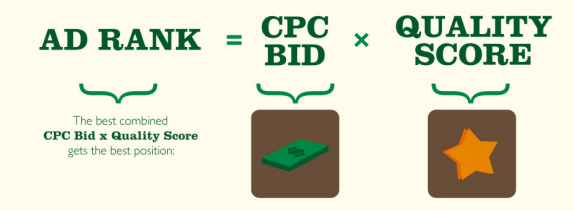
The mechanism runs through Ad Rank, which decides whether your ad shows and where. Ad Rank is set at auction time using your bid, the auction-time quality of your ad and landing page, the context of the search, and the expected impact of your assets and formats. The cheaper-clicks effect is real: raise the quality signals behind a keyword and you can hold the same position at a lower bid, or move up without paying more.
This is why Quality Score is worth watching even though it is not a live auction input. It is the clearest read-out Google gives you on the same quality signals the auction is judging.
Is Quality Score actually used in the ad auction?
No – the 1–10 Quality Score you see in your account is a diagnostic metric, not a value used directly in the live auction. Google has confirmed this. What the auction uses are real-time quality signals measured for each individual query, which is not the same as the aggregated score on your dashboard.

The confusion is understandable because the auction weighs the same three ideas that make up Quality Score: expected CTR, ad relevance, and landing page experience. So the number is a lagging, aggregated estimate of live signals rather than the input itself. Two advertisers can show the same Quality Score and still land different Ad Ranks, because their bids and auction-time signals differ.
The practical takeaway: do not treat Quality Score as a KPI to optimise towards. Treat it as a gauge. When a component slips to “Average” or “Below average,” it is pointing at a fixable weakness. Judge the campaign itself on cost per acquisition and return on ad spend.
What are the three components of Quality Score?
Quality Score is made up of expected click-through rate, ad relevance, and landing page experience – and they are not weighted equally. Analysis by Adalysis estimates that expected CTR and landing page experience each carry roughly 39% of the weight, with ad relevance at around 22%.
Expected click-through rate
This estimates how likely your ad is to be clicked when it shows for your keyword, based on past performance. Google’s aim is to serve results people actually want, and click-through is one of its clearest signals of that. A low expected CTR reads as “this ad is not what searchers are looking for.” Sharper, more specific ad copy that mirrors the keyword’s intent is the direct lever.
Ad relevance
This measures how closely your ad matches the intent behind the keyword. A “Below average” grade usually means the ad group is trying to cover too many themes at once, so no single ad speaks precisely to any one search. Tightly themed ad groups — fewer keywords per group, with ad copy written for that specific intent — are the standard fix.
Landing page experience
This rates how relevant, useful, and easy to navigate your landing page is once someone clicks. It is the most under-invested of the three, despite carrying as much weight as expected CTR. Google evaluates it with a mix of automated systems and human review, and looks for four things:
- Relevance and value: content that matches the search and offers something original and useful.
- Transparency and trust: clear information about your business, product, or service before you ask for a form fill.
- Ease of navigation: people can find what they came for quickly, especially on mobile.
- Speed: pages that load fast. Slow pages and high bounce rates drag the score down.
The highest-leverage move here is sending each ad group to a page that matches its promise, rather than dumping all traffic on the homepage. Someone who searched “gold necklaces” should land on the gold necklaces page, not a general jewellery page. Mismatch causes pogo-sticking — the click straight back to search results — which Google reads as a poor experience.
What is a good Quality Score?
A Quality Score of 7 or above is good; 5 is roughly average, and 10 is rare and often not worth chasing on competitive keywords. According to WordStream’s account research, the average score across thousands of Google Ads accounts sits around 5 to 6, so a consistent 7 already puts you ahead of most advertisers.
Scores of 10 are realistic on branded terms and specific long-tail keywords, but the CPC gap between a 9 and a 10 is small next to the effort needed to close it on competitive terms. Spend that effort where a keyword is stuck at 3 or 4 and dragging up your costs — that is where the money is. If you see a “—” instead of a number, the keyword simply has not had enough exact-match searches for Google to score it yet.
How do you improve your Quality Score?
You improve Quality Score by fixing whichever component is graded lowest, not by treating the number as a target. Add the component columns in your account (Exp. CTR, Ad Relevance, Landing Page Exper.), find the “Below average” grades on your highest-spend keywords, and work those first.
- Low expected CTR: rewrite ad copy to match the keyword’s intent, and pull the keyword into the headline where it reads naturally.
- Weak ad relevance: split broad ad groups into tighter, single-theme groups so each ad answers one kind of search.
- Below-average landing page experience: point the ad group at a page that matches its promise, tighten load speed, and make sure the page keyword and the ad keyword agree.
Because landing page experience carries as much weight as expected CTR and is the most neglected of the three, it is often the fastest win. A dedicated landing page that delivers on the ad’s promise can move the score within three to four weeks of collecting enough data.
When Quality Score is not the thing to fix
Quality Score is a search-campaign, keyword-level metric — so in several common setups, it is the wrong place to look. Performance Max campaigns have no keyword-level Quality Score at all; there are no keywords to attach a score to. The equivalent signal there is the asset group rating (Low, Good, or Best), which grades the quality and range of your headlines, descriptions, images, and videos.
Broad match under automated bidding also muddies the read. A broad match keyword can sit at a low score simply because it now maps to a very wide spread of intent that no single ad can look perfectly relevant across. In that case the low number is a structural artefact, not a copy problem to solve. And if a campaign is unprofitable while Quality Scores look fine, the answer is not in this metric — check targeting, offer, bids, and conversion tracking instead.
This is where an outside read helps: knowing which lever actually moves an account, and which numbers to ignore. At CloudRock, we run paid search for FMCG, F&B, and B2B businesses in Singapore as a strategy problem first and a dashboard problem second. If your Google Ads costs are climbing and you are not sure whether Quality Score is the cause or a distraction, book a discovery call and we will tell you plainly.
Frequently asked questions
What is Google Ads Quality Score?
Google Ads Quality Score is a 1–10 diagnostic rating, assigned per keyword in Search campaigns, that estimates how relevant and useful your ad, keyword, and landing page are to a searcher. It is built from three components: expected click-through rate, ad relevance, and landing page experience. A higher score generally means a lower cost per click and better ad placement.
Does Quality Score directly affect the ad auction?
No. The visible 1–10 Quality Score is a diagnostic metric and is not used directly in the auction. The auction uses real-time quality signals measured per query, which are based on the same three ideas – expected CTR, ad relevance, and landing page experience – but are calculated live rather than taken from your dashboard number.
What is a good Quality Score in Google Ads?
A Quality Score of 7 or higher is good, 5 is about average, and 10 is rare. According to WordStream, the average across accounts sits around 5 to 6, so reaching a steady 7 puts you ahead of most advertisers. Chasing a 10 on competitive keywords is usually not worth the effort for the small extra CPC saving.
How long does it take to improve Quality Score?
Improvements usually appear within three to four weeks once a change has gathered enough exact-match search data. Landing page fixes tend to move the score fastest because landing page experience carries roughly 39% of the weight and is the most commonly neglected component.
Why does my keyword show a dash instead of a Quality Score?
A “—” means the keyword has not had enough searches that exactly match it for Google to calculate a reliable score. This is common for new or low-volume keywords. The score usually populates once the keyword accumulates enough exact-match impressions.